
Object: V0432 Persei, eclipsing binary variable star
Date: October 3, 2026 UT
Location: Near Corvallis, Oregon
Telescope: Askar 71F apochromatic refractor, 71 mm aperture, 490 mm focal length, f/6.9
Camera: Canon EOS Rebel XSi (450D), unmodified
Mount: iOptron SkyHunter
Exposure: 30 seconds, ISO 800
Light frames: 200 acquired
Dark frames: 20
Registration: 193 successful, 7 failed
Photometric measurements: 191 records exported
Image scale: 2.189 arcseconds/pixel
Plate-solved focal length: 489.98 mm
Field of view: 2°35′51″ × 1°43′54″
Field center (J2000): RA 03h 09m 29.829s, Dec +42°42′31.61″
Processing software: Siril 1.4.4
Photometric method: Differential aperture photometry
What accomplished
First attempt to obtain a light curve of an eclipsing binary using DSLR. I’d never used a DSLR to do photometry before.
Acquired 200 exposures over approximately two hours, performed image calibration and registration, and used Siril’s photometry tools to measure the variable and comparison stars.
Subsequently exported 191 measurements to a CSV file for analysis. Sent all measurements to AAVSO, observer code BJM.
Principal result: Recorded a portion of one ascending branch of the variable’s light curve, insufficient for determining a time of minimum (TOM).
Nevertheless, the exercise gave experience with Siril software in doing differential photometry, data reduction, and preparation of measurements for submission to the AAVSO.
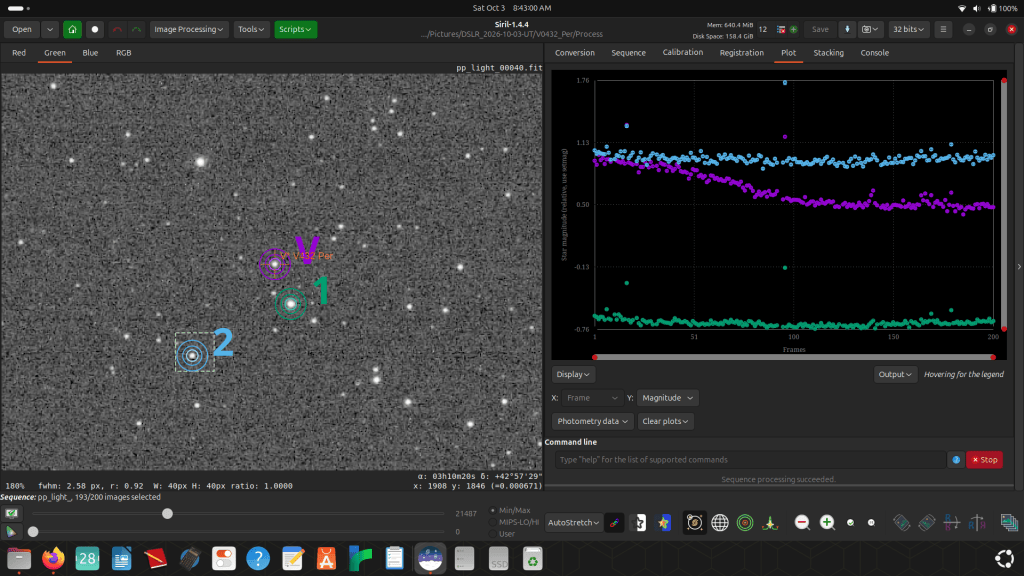
Screenshot of Siril showing variable, comp, and check stars on one image, and magnitudes (brightness increasing DOWNWARD) for variable (purple), comp (green) and check (blue)
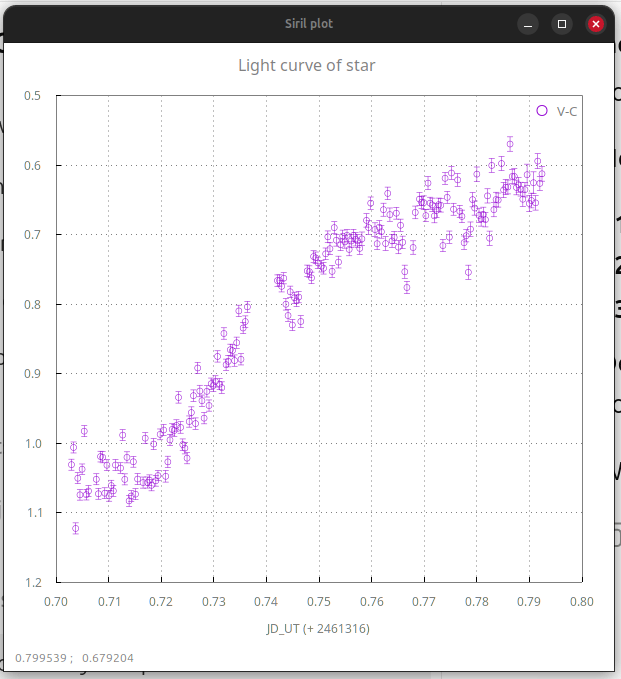
Plot of the differential magnitude for the variable, brightness increasing UPWARD (magnitude numbers increase downward).


Leave a Reply