
Object: M45, the Pleiades open star cluster
Date: October 6, 2026 UT
Location: Near Corvallis, Oregon
Telescope: Askar 71F apochromatic refractor, 71 mm aperture, 490 mm focal length, f/6.9
Camera: Canon EOS Rebel XSi (450D), unmodified
Mount: iOptron SkyHunter
Exposure: 20 seconds, ISO 800
Light frames: 40 acquired
Light frames stacked: 34 (6 rejected)
Dark frames: Master dark from an earlier 20-second exposure sequence
Total integrated exposure: 11 minutes 20 seconds
Image scale: 2.190 arcseconds/pixel
Plate-solved focal length: 489.66 mm
Field of view: 2°35′58″ × 1°43′58″
Field center (J2000): RA 03h 46m 41.533s, Dec +24°00′49.13″
Processing software: Siril 1.4.4
Photometric color calibration: 877 catalog stars used
What accomplished
This was a relatively short imaging session directed at one of the most familiar open star clusters in the night sky.
Acquired 40 exposures of 20 seconds each, retaining 34 after registration and rejection.
Processed in Siril including calibration, registration, stacking, photometric color calibration, and histogram stretching.
The principal challenge was revealing the faint blue reflection nebulosity surrounding the brighter Pleiades stars.
Unlike emission nebulae, which radiate strongly at particular wavelengths, reflection nebulae shine primarily by scattering light from nearby stars. In the Pleiades, dust scatters the blue light of the hot, luminous cluster members particularly efficiently.
With only 11 minutes 20 seconds of integrated exposure, the faint nebulosity was difficult to bring out, but the session provided useful experience with color calibration and stretching.
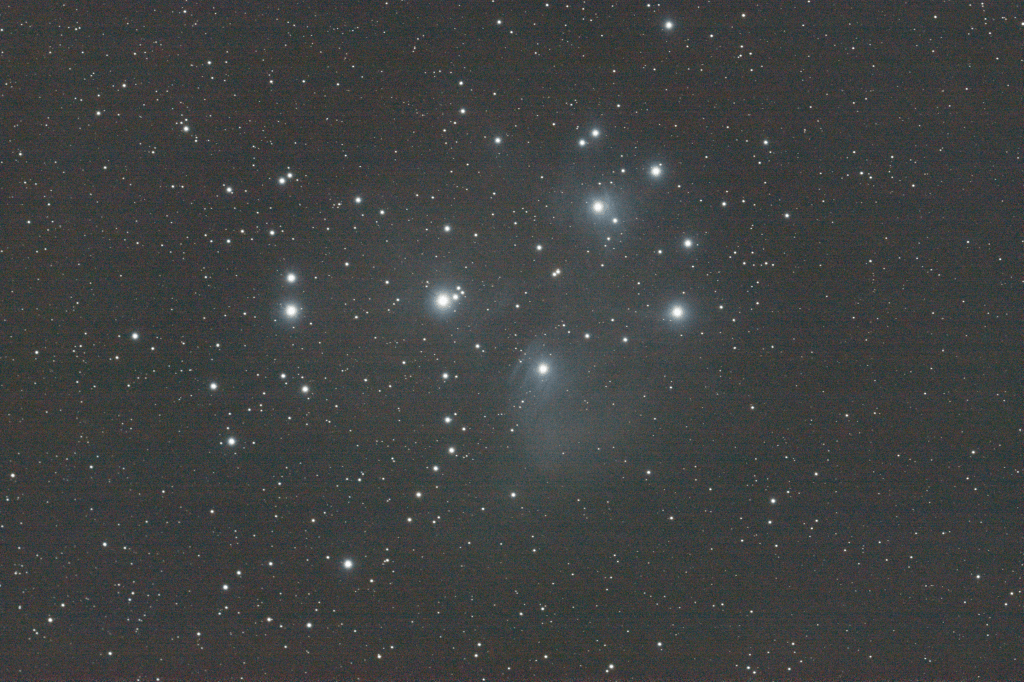
M45 (Pleiades), October 6, 2026 UT. Askar 71F refractor and Canon EOS 450D. Stack of 34 twenty-second exposures at ISO 800. Processed in Siril.


Leave a Reply