
Objects: Saturn and three moons: Titan, Tethys, and Rhea
Date: October 8, 2026 UT
Location: Near Corvallis, Oregon
Observing interval: Approximately 05:45–06:40 UT (10:45–11:40 p.m. PDT, October 7)
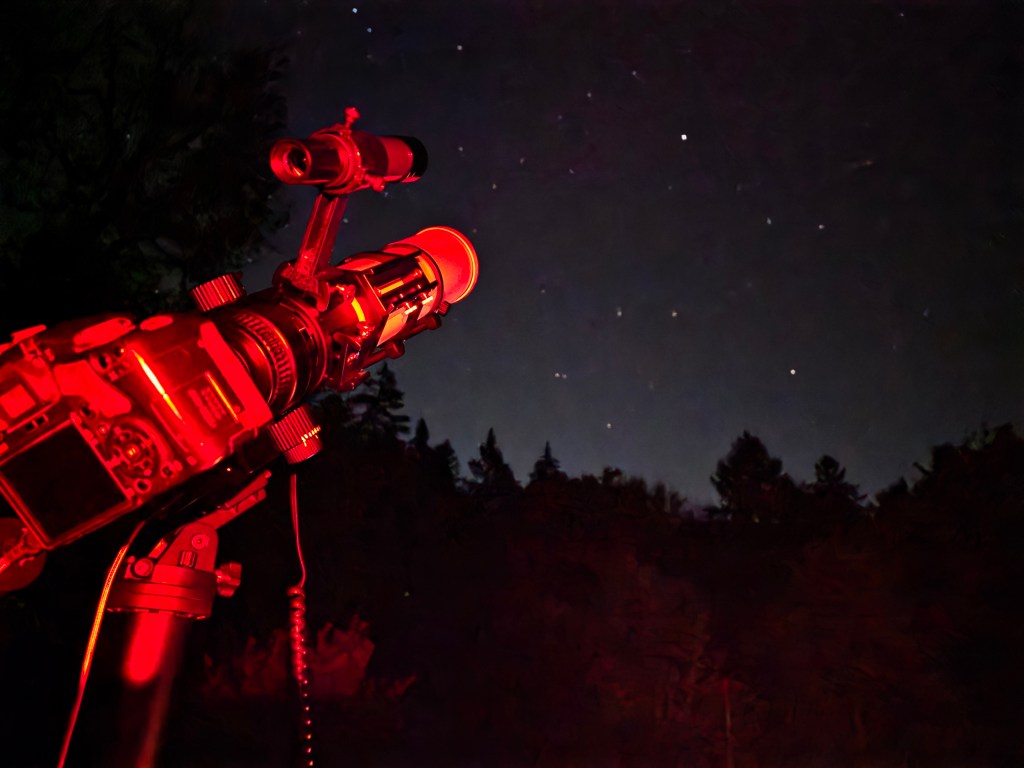
Telescope: Askar 71F apochromatic refractor, 71 mm aperture, 490 mm focal length, f/6.9
Camera: Canon EOS Rebel XSi (450D), unmodified
Mount: iOptron SkyHunter
Image scale: 2.188 arcseconds/pixel
Processing software: Siril 1.4.4 and GIMP
Exposure sequences
Obtained three sets of light frames at different exposure lengths, each accompanied by dark frames.
| Exposure | Light frames | Dark frames | Purpose |
|---|---|---|---|
| 0.01 second | 25 | 25 | Saturn’s disk and rings |
| 2 seconds | 150 | 25 | Satellites close to Saturn’s glare, caused by the optics |
| 10 seconds | 50 | 25 | Possible fainter satellites farther from glare |
| Total | 225 | 75 |
The total exposure time for the light frames was approximately 12 minutes 30 seconds.
Image calibration and processing
Processed the three exposure sequences separately in Siril, creating master dark frames appropriate to each exposure length. The calibrated images were registered and stacked to improve the signal-to-noise ratio.
The 0.01-second exposures preserved detail in Saturn’s bright disk and rings, while the longer exposures revealed satellites that were otherwise lost in the planet’s glare. The longer exposures necessarily overexposed Saturn itself.
Subsequently combined the different exposure stacks in GIMP, using the short-exposure image for Saturn and the longer-exposure images for the surrounding satellites. It turned out that the 10 second data didn’t reveal any more satellites than the three — Titan, Tethys, and Rhea — found with the 2 second dataset.
Astrometric information
The plate solution for the 2-second sequence gave:
Image scale: 2.188 arcseconds/pixel
Effective focal length: 490.22 mm
Field of view: 2°35′47″ × 1°43′51″
Plate-solved field center (J2000): RA 00h 43m 39.794s, Dec +01°40′28.08″
Orientation: North approximately 1.29° counterclockwise from image vertical.
Identification of Saturn’s satellites
Positively identified three satellites in the composite image:
Titan: The brightest and most easily detected satellite, appearing below Saturn in the south-up image.
Tethys: Visible to the right of Saturn.
Rhea: Farther to the right, beyond Tethys.
Compared the observed positions with a contemporary satellite-position chart from Sky & Telescope and with Stellarium (see image from Stellarium below).
Observational results
The experiment demonstrated that even a relatively small refractor and an unmodified DSLR can record several of Saturn’s satellites.
The principal challenge was the enormous brightness difference between Saturn itself and its moons. Saturn’s disk required exposures of only 0.01 second to avoid saturation, whereas exposures of 2 to 10 seconds were needed to reveal the satellites. HERE ARE THE IMAGES:
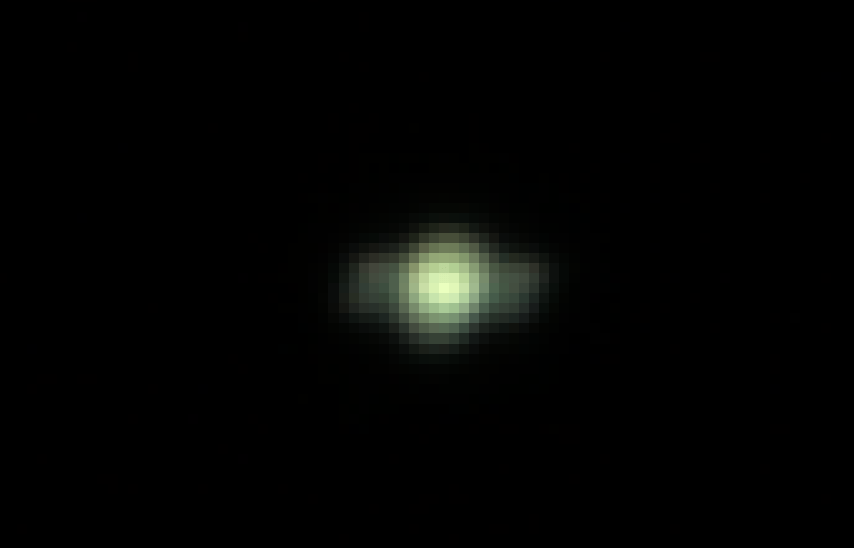
(above) Saturn 0.01 second stack of 25. Detail constrained by telescope/sensor combination.
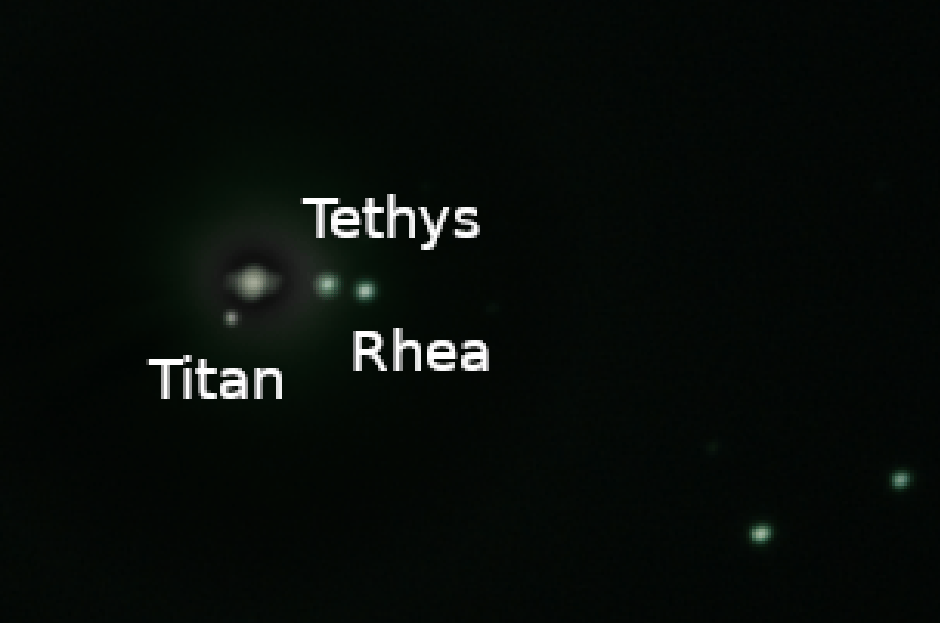
(above) Cropped image of Saturn (unlabeled) with three satellites. South is up, west to the right. The two objects to the far lower right are field stars. Brightness of moons greatly exaggerated.
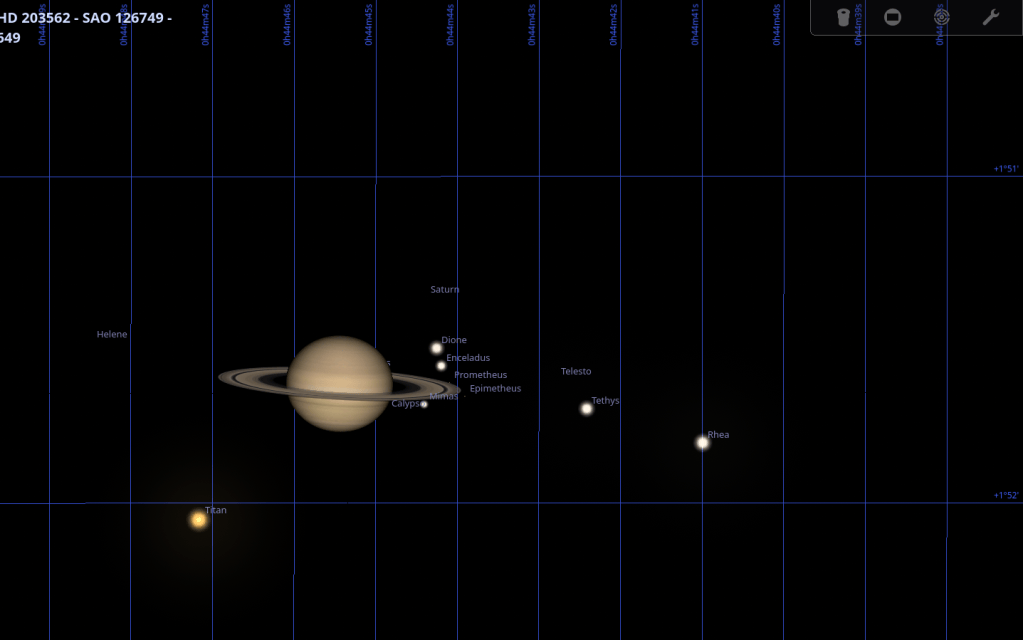
(above) Artificial portrait of Saturnian system at the time of observation generated in Stellarium. South is up and west is to the right. Titan, Tethys, and Rhea correspond to the image obtained with the camera.
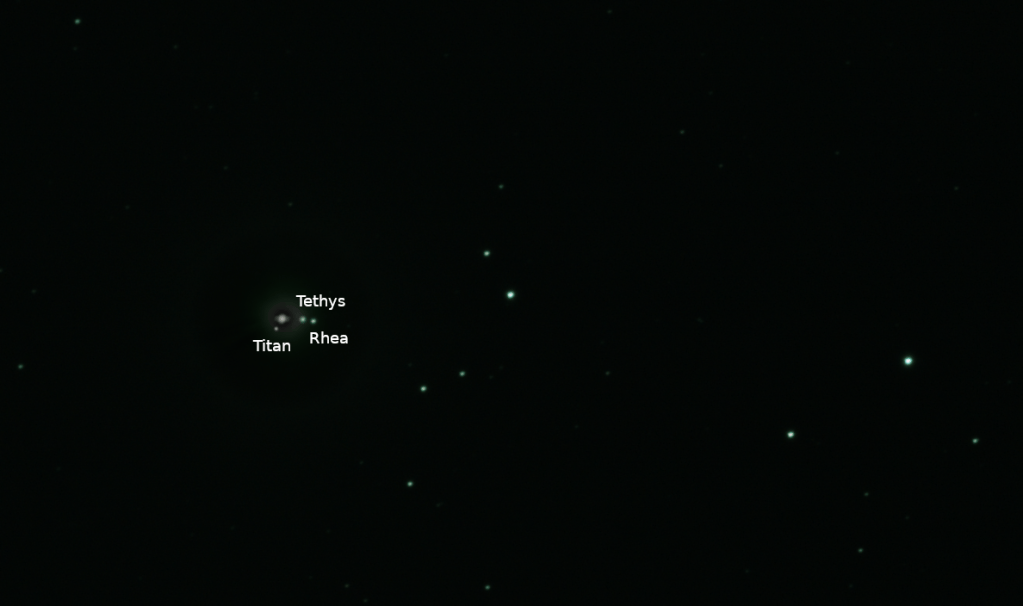
Final composite. Still cropped but larger field of view showing more field stars. Brightness of moons greatly exaggerated.


Leave a Reply